
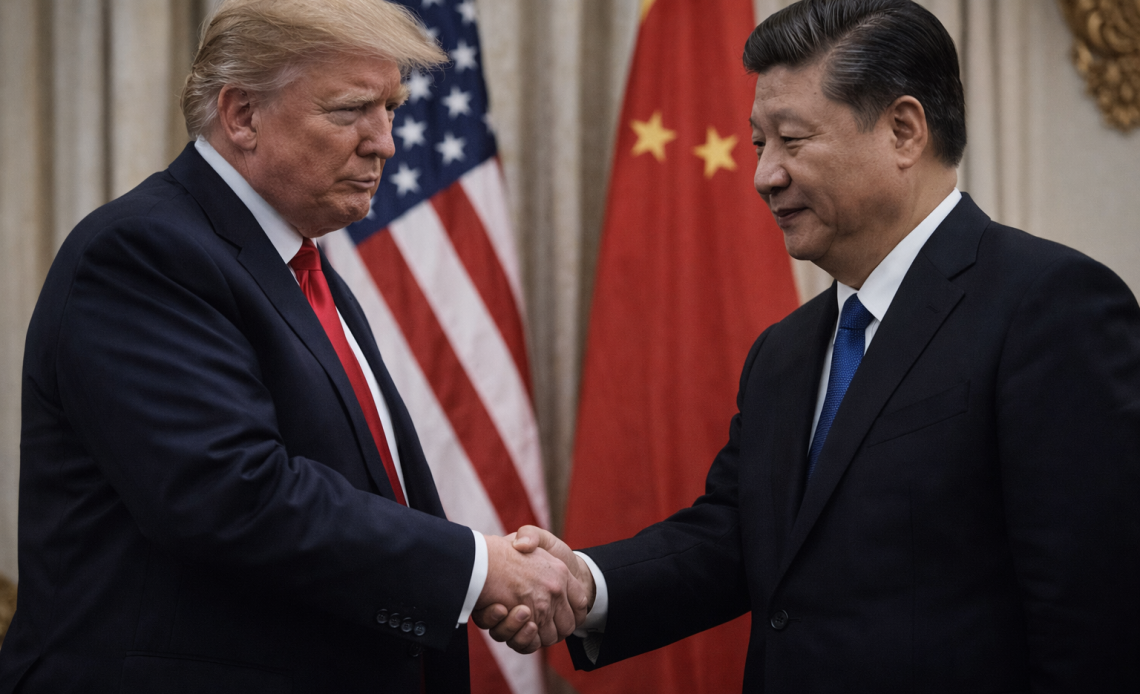
US President Donald Trump and China’s President Xi Jinping are all set to meet in May this year.
The high-profile meeting is enough to move markets, reset expectations and revive the idea that the world’s two biggest economies were still trying to find a stable bargain.
But in 2026, that assumption looks far harder to defend.
That is not because diplomacy no longer matters. It does. A summit can still cool rhetoric, reopen channels and buy both sides a little time.
But the numbers now suggest that the deeper story sits in semiconductor controls, trade patterns, and supply-chain leverage.
There is a growing belief among executives and policy experts that the relationship is being driven by structure, not statesmanship.
The case for a more limited summit starts with one of the most important companies in the global AI boom.
Nvidia’s annual report shows China, including Hong Kong, accounted for 20.24% of revenue in fiscal 2024, 19.19% in fiscal 2025 and just 9.11% in fiscal 2026, using the company’s recast geography based on customer headquarters location.
The fall is striking not only because of its speed, but because it captures how a flagship US tech company is already adapting to a world in which China is no longer treated as a dependable engine of growth.
The real rupture is in technology, not diplomacy
Jensen Huang has been unusually plain about that shift.
In June 2025, Nvidia signaled it would no longer include China in its forward forecasts after tightening US export controls, with Huang saying he was “not counting on” a policy reversal.
Since then, Washington has allowed some limited sales to resume, including licensed exports of certain chips to approved customers, but access remains tightly controlled and politically contingent.
A month earlier, Huang said Nvidia’s market share in China had fallen to 50% from 95% at the start of the Biden administration.
Those are not the words of a chief executive waiting for one summit to restore the old commercial order.
They are the words of someone adjusting to a structural break.
Trade is still enormous, but it no longer carries the old promise
The second reason a summit may matter less than it once did is that bilateral trade, while still huge, no longer tells a story of deepening convergence.
US-China goods trade totaled $635.2 billion in 2017, rose to $658.8 billion in 2018, and fell sharply during the trade-war years.
The trade rebounded to a peak of $690.3 billion in 2022, and then slipped to $574.9 billion in 2023 before edging up to $582.0 billion in 2024.
That is not a collapse. But neither is it a return to the old confidence that commerce would steadily knit the relationship together.
The same pattern shows up in US exports to China.
Goods exports stood at $130.0 billion in 2017, fell to $106.5 billion in 2019, recovered strongly in 2021 and 2022, and then eased to $143.2 billion in 2024.
In other words, trade still exists at vast scale, but its political meaning has changed.
It is now happening under suspicion, with both sides more willing to sacrifice efficiency for resilience, leverage or security.
That is why Brad Setser’s line lands so hard.
As cited in Epoch Investment Partners’ 2026 outlook, “Open trade failed, spectacularly, to liberalize China’s political system.”
Epoch’s broader argument is even more blunt: bilateral trade could decline by more than 50% through 2030 as activity with national-security implications is increasingly home-shored.
That may prove too stark. But it captures the direction of travel better than any summit slogan about stability.
Supply chains now matter more than diplomacy
If tech controls show the rupture and trade data show the drift, rare earths show the hard edge of leverage.
China accounts for roughly 69% of global rare-earth mine production and 92% of processing, according to PwC’s 2025 mining review, figures echoed by CSIS in its 2026 survey analysis.
That does not mean Beijing has unlimited power.
It does mean that in one of the most strategically sensitive supply chains in the world, dependence remains real and alternatives remain slow to build.
That is why the summit question can be misleading. A cordial meeting may create the impression of movement, even while the most important vulnerabilities remain untouched.
As Fortune reported this month, analyst Gracelin Baskaran said China has been building its processing edge for more than 30 years, while non-Chinese capacity remains comparatively small-scale.
That is not the kind of imbalance a handshake undoes.
Then there is the trust problem. In the CSIS China Power Project survey of 79 former officials and China experts, only 3% said both sides were likely to keep all their commitments in 2026.
Just over half expected both to make partial efforts but fall short, while 34% said neither side was likely to meet its commitments.
None of the respondents believed Beijing would meet its commitments while Washington kept its own; 13% thought the reverse was more likely.
CSIS tied that skepticism in part to China’s failure to meet commitments under the Phase One trade deal in Trump’s first term.
That leaves the summit in a narrower place than the optics suggest.
It can still matter in tone. It can still steady markets for a week or two. It can still give both governments a way to claim they are managing the rivalry responsibly.
But the five charts point to a more uncomfortable truth: by 2026, the US-China relationship is being shaped less by leader chemistry than by export controls, strategic dependencies and a trust deficit that no joint statement can easily erase.
The post 5 charts that show why Trump-Xi summit may not matter in 2026 appeared first on Invezz