
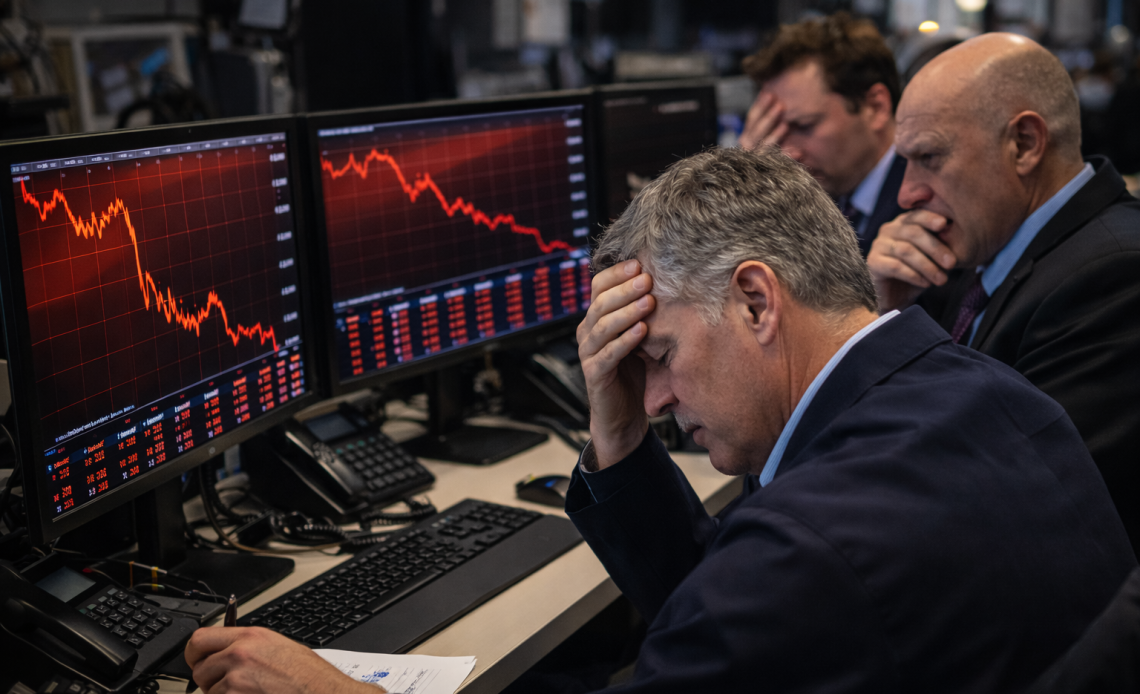
European shares sank to one-month lows on Tuesday as a deepening global equities rout gathered momentum.
Investors were rattled by the prospect of a prolonged Middle East conflict and a renewed surge in oil prices that could reignite inflation across the region.
The pan-European STOXX 600 index fell 3.26%, leaving it on course for its sharpest single-day decline since April.
The selloff was broad-based, with every sector in negative territory as markets shifted firmly into risk-off mode.
Major indexes hit multi-week lows
Germany’s DAX dropped nearly 4%, touching its lowest level in almost two months.
France’s CAC 40 slid 3.12%, while Spain’s IBEX 35 tumbled around 4.5%, hitting an over two-month low.
London’s FTSE 100 fell 2.6%.
Financial stocks bore the brunt of the decline.
The banking index slid to a near three-month low, with UK-focused lenders among the hardest hit amid concerns over exposure to Middle East-linked risks.
Insurance stocks also weakened sharply, falling 3.9%. Energy shares offered little refuge despite rising crude prices.
The sector edged down 1.1%, underscoring investor concern that higher oil prices could dampen demand and growth rather than simply boost profits.
Travel and airline stocks remained under sustained pressure.
Germany’s Lufthansa dropped 4.6%, British Airways owner IAG fell 2.37%, and Air France-KLM slid 7% as fears mounted over fuel costs and regional instability.
Oil shock and inflation concerns
Markets have been unsettled since the United States and Israel launched an air campaign against Iran over the weekend, striking Tehran and killing Supreme Leader Ali Khamenei.
Iran and its proxy Hezbollah responded with retaliatory action, escalating tensions across the Gulf.
The closure of the Strait of Hormuz has disrupted commercial shipping through one of the world’s most vital energy corridors.
Europe, heavily reliant on oil and gas flows from the region, faces the risk of a renewed energy shock.
Investors fear that sustained higher oil prices could rekindle inflation at a time when economic growth in the euro zone remains fragile.
Carsten Brzeski of ING said the euro zone was the “most exposed major economy” to spillovers from Iran, given its dependence on regional energy supplies.
A prolonged spike in crude would complicate the outlook for both the European Central Bank and the Bank of England.
“Much will depend on the price of oil,” said Jim Reid of Deutsche Bank.
“Any sustained spike would undoubtedly trigger a more meaningful risk-off move, but without that, markets are likely to revert fairly quickly to focusing on macro data and AI-related themes.”
Philip Lane, chief economist at the European Central Bank, told the Financial Times that an extended conflict could push inflation significantly higher while weighing on eurozone growth.
Uncertain outlook for markets
US President Donald Trump has provided limited detail on the expected duration of the strikes, outlining broad objectives related to countering Iran’s nuclear threat.
Defence Secretary Pete Hegseth described the campaign as not “endless” but framed it as a generational opportunity to reshape the Middle East.
Secretary of State Marco Rubio warned that “the hardest hits are yet to come.”
For now, investors remain focused on whether the conflict will escalate further.
A drawn-out war risks derailing Europe’s tentative recovery and reigniting inflationary pressures that policymakers have only recently brought under control.
The post DAX, CAC, STOXX sink over 3% as Middle East tensions escalate appeared first on Invezz