How does grabbing a chicken roll in Kolkata—a city famed for its vibrant culinary heritage—connect to the US-Israel-Iran war raging in the Middle East? Surprisingly, it does—a lot.
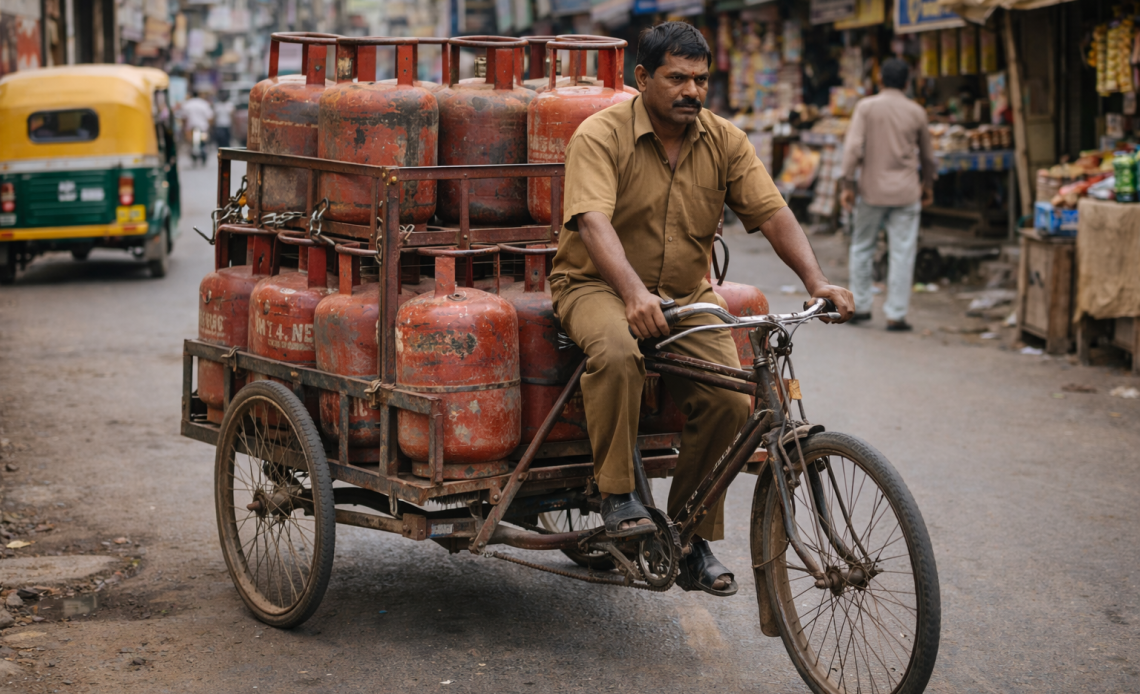
Samir Ray, who runs a bustling fast-food stall serving hundreds daily, told Invezz he may soon have to shut down amid India’s worsening LPG cylinder shortage, directly linked to the supply disruptions caused by the Strait of Hormuz blockade.
The crunch has street vendors and popular eateries scrambling, trimming menus and suspending food delivery app listings.
And it’s not just eateries, even fish retailers in Kolkata’s New Market, where orders from restaurants have dwindled over the last few days, are feeling the heat.
“The impact is low currently, but if the situation continues to deteriorate, many restaurants and caterers will reduce and possibly cancel orders,” Soumajit Roza, owner of Roza Traders, a top fish retailer in Kolkata, told Invezz.
The story echoes across the country.
“If the issue is not solved in a few days, it will take a very dangerous turn,” GS Shukla, a second-generation owner of the nearly 100-year-old Shukla Tea Stall in Lucknow, told Invezz, adding that temporarily shutting the restaurant cannot be ruled out.
Is there an alternative to LPG?
In Lucknow, the north Indian city designated a UNESCO Creative City of Gastronomy last year, restaurant owners known for serving the region’s rich Awadhi cuisine have begun replacing LPG with coal and firewood in their kitchens.
Some eateries have also started using diesel furnaces as an alternative.
At Shukla Tea Stall, which serves tea and snacks, LPG cylinders have been replaced with a diesel furnace, while a commercial induction stove is being used for smaller utensils.
The war in the Middle East between the US, Israel, and Iran has placed major stress on India’s liquefied petroleum gas supply.
India is the world’s second-largest LPG importer, and the country’s supply is already heavily reliant on imports and government support.
Government diverts LPG supply to households
Last year, the Indian government provided a $3.25 billion subsidy to the country’s three public sector oil marketing companies (OMCs) — Indian Oil Corporation, Bharat Petroleum Corporation, and Hindustan Petroleum Corporation.
This payment was intended to compensate the companies for losses incurred from selling cooking gas at subsidised rates during a period of rising global prices.
The central government’s initial intention was to protect consumers from increasing global LPG prices by having OMCs absorb the cost through a grant.
However, this grant was announced before the war began.
With the conflict intensifying, India now faces the potential for supply disruptions and further increases in global LPG prices.
Following the onset of the Middle East conflict, domestic LPG prices saw a jump of $0.8 per cylinder on March 7, just a week later.
This price hike coincided with a surge in Brent crude, which briefly touched nearly $120 a barrel, marking the first time it had breached the $100 per barrel threshold since the Russian invasion of Ukraine in 2022.
The Ministry of Petroleum and Natural Gas ordered domestic oil refiners and petrochemical complexes on March 9 to maximise LPG production and supply all of it exclusively to IOCL, HPCL, and BPCL.
Refiners cannot divert output for other petrochemical use, and OMCs must supply LPG only to domestic consumers.
“New Delhi has diverted more domestic output towards homes and essential users. This probably means a disruption beyond 2-3 weeks may be really tough for hotels and restaurant businesses,” Tapas Peshin, senior product manager at PCI Energy Solutions, told Invezz.
According to government data, India has about 332 million active domestic LPG connections, with annual demand around 31.3 million tonnes.
Household demand accounts for nearly 90% of the country’s total LPG consumption.
War exposes India’s LPG import dependence
India produces only about 40% of its LPG requirement domestically, leaving roughly 60% to be met through imports.
Most of these imports originate from the Middle East — including Qatar, Saudi Arabia, Kuwait, Oman, Bahrain and the United Arab Emirates — which together account for about 85–90% of shipments.
Much of this supply also passes through the Strait of Hormuz, a key global shipping chokepoint currently facing disruptions.
India has also begun diversifying its supply.
Under a deal signed in November 2025, the country agreed to import 2.2 million tonnes of LPG annually from the United States, accounting for nearly 10% of its total yearly LPG imports.
However, overall dependence on imports has grown sharply in recent years, driven largely by the expansion of clean cooking initiatives.
The International Energy Agency’s Indian Oil Market Outlook to 2030 noted that these programmes pushed LPG imports up significantly over the past decade, with volumes rising from about 16.48 million metric tonnes in 2020–21 to more than 18 MMT by 2025–26.
Restaurants revert to coal and firewood
At Naushijaan, one of Lucknow’s most iconic restaurants, renowned for its Mughlai specialties like biryani and kebabs, the manager told Invezz that coal now powers the barbecue while firewood fuels the preparation of other dishes.
“We have halved the quantity of many dishes. We used to prepare about 8 kgs of biryani every day. Now, we are preparing only about 4 kg. We will also have to limit restaurant timings if this crisis continues,” the manager said.
Similarly, Kolkata’s celebrated biryani chain Arsalan has reverted to time-honoured cooking methods to weather the LPG shortage.
According to Mozammal Haque, manager of the Park Circus branch, they are now relying on wood-burning stoves to offset the equivalent of 70 cylinders daily across their 12 outlets.
“We are forced to buy cylinders at inflated prices from areas like Dankuni just to keep the fires burning,” Haque added.
Meanwhile, at Dastarkhwan, another beloved restaurant in Lucknow, the menu has been overhauled with certain dishes removed entirely, and the kitchen now operates entirely on coal and firewood.
However, the owner conceded that cooking with coal and firewood takes more than double the time, severely limiting the restaurant’s ability to prepare large quantities.
India faces concentration risk
PCI Energy Solutions’ Tapas Peshin told Invezz that the immediate impact on freight and insurance costs for vessels rerouting outside the Strait of Hormuz would likely prove smaller in scale, yet still noticeably burdensome.
“Based on the recent reports coming out, it sounds like insurance for these vessels has jumped from 0.25% to 3% because of the war. This is definitely a higher jump compared to past disruptions,” Peshin said.
Meanwhile, oil minister Hardeep Singh Puri announced on Thursday that India is broadening its procurement of LPG cargoes.
In addition to longstanding suppliers in the Gulf, the country is now pursuing supplies from emerging international markets, including the US, Norway, Canada, and Russia.
However, Peshin cautioned that these alternatives may not fully offset disruptions in the short term.
“With all the issues around voyage time, terminal capacity, and shipping availability, these may not be the perfect short-term substitutes to meet the shortfalls, but substitutes nonetheless,” he said.
Puri also said that oil marketing companies will allocate 20% of the average monthly commercial LPG requirement starting Thursday, working alongside state governments to curb hoarding and black marketing.
India’s cooking gas consumption reached 33.15 million metric tonnes last year, with imports meeting about 60% of demand.
“The central lesson is that India does not just have an import-dependence problem, but also it has a concentration-risk problem,” Peshin said.
“For India’s energy security, we should focus on route diversity, storage depth, and contractual optionality. Lessons from crude security can also be applied to LPG security.”
For now though, far from the battlefields of the Middle East, Kolkata’s street stalls and Lucknow’s tandoors tell the real story—a stark reminder that modern wars still ignite chaos in the most unexpected places.
With inputs from Vatsala Gaur.
The post From Kolkata to Lucknow, Hormuz blockade fuels LPG crisis for eateries appeared first on Invezz