
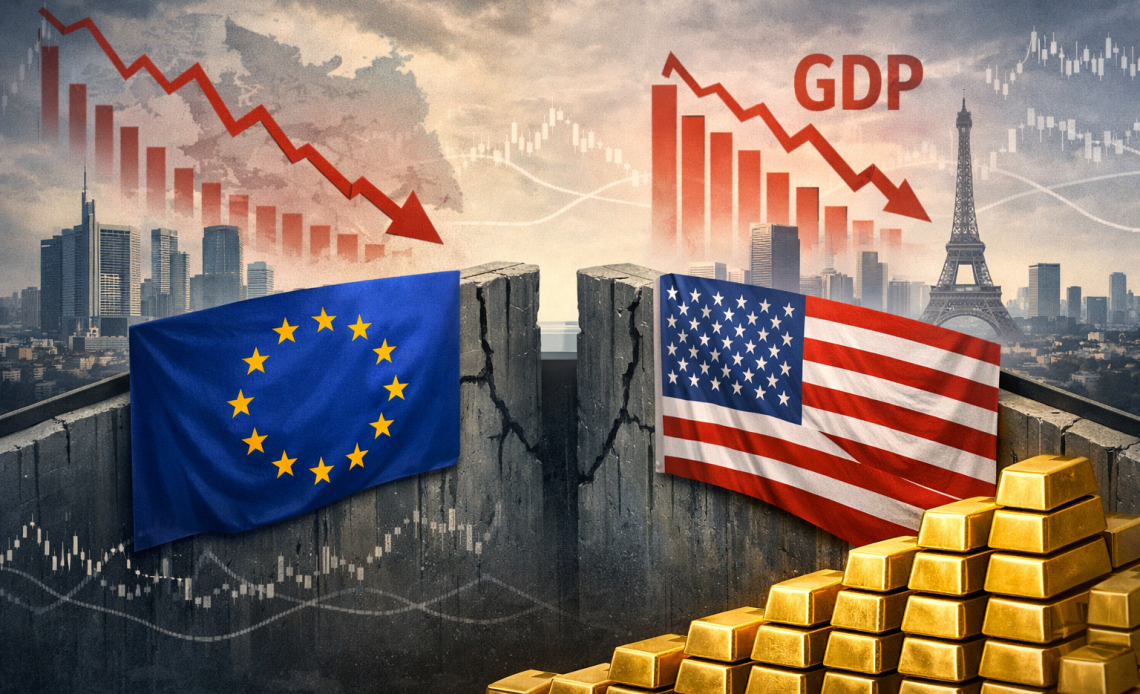
Goldman Sachs Group Inc. economists estimate that the latest tariff threat from US President Donald Trump could shave about 0.1% off the euro area’s gross domestic product, underscoring the economic risks tied to escalating transatlantic trade tensions.
Trump said on Saturday that he would impose a 10% tariff on imports from several European countries that have rallied to support Greenland in response to US threats to seize the semi-autonomous Danish territory.
The proposed levies would apply to Denmark, Norway, Sweden, France, Germany, Finland, the United Kingdom, and the Netherlands.
The announcement has added to market unease at a time when investors are already sensitive to geopolitical risks and the durability of Europe’s economic recovery.
However, despite this, Goldman Sachs sees limited impact for Europe from the latest tariffs as the broader economy remains resilient.
Goldman outlines GDP impact across Europe
According to the Goldman Sachs analysis, a 10% duty would reduce real GDP by roughly 0.1% to 0.2% across the affected countries, primarily through weaker trade flows.
Germany, Europe’s largest economy and a major exporter, would bear the largest impact.
The Goldman team estimates Germany’s GDP could fall by around 0.2% if the tariffs are applied as an incremental reciprocal measure, and as much as 0.3% if they take the form of a blanket levy.
“The hit could be larger should there be adverse confidence or financial market effects,” the team, including Sven Jari Stehn, wrote in a note.
The economists cautioned that the outlook remains uncertain, noting that it is still unclear whether the tariffs will ultimately be implemented.
Nonetheless, they said the threat alone is enough to weigh on confidence and prompt contingency planning among policymakers and investors.
Goldman expects limited impact from tariffs
Global financial markets were rattled following Trump’s comments, with European equities and US index futures sliding at the start of the week.
At the same time, traditional safe-haven assets such as gold rallied, reflecting a shift toward risk aversion.
Despite the immediate market reaction, a number of strategists suggested that the impact on European equities could prove short-lived.
They argued that the region’s broader economic outlook remains resilient, even in the face of renewed trade frictions.
Recent data show euro-area growth holding up, supported by easing inflation pressures and the prospect of further monetary policy support.
Goldman economists also said they expect only a “very small” impact on inflation from the proposed tariffs, adding that central banks would likely lower interest rates in response to a weaker GDP outlook.
EU weighs response as diplomacy remains an option
Goldman Sachs said a potential European Union response to the tariff threat could range from delaying approval of a US-EU trade deal to imposing counter-levies or deploying the bloc’s so-called anti-coercion instrument.
They added that the United Kingdom is expected to prioritize diplomatic engagement with Trump, similar to its approach during trade negotiations last year.
Separately, people familiar with the matter said the EU is in talks about imposing tariffs on €93 billion ($108 billion) of US goods and is considering additional countermeasures beyond tariffs.
However, officials are expected to first pursue a diplomatic solution before escalating further.
While the immediate economic hit from the proposed tariffs appears modest, economists warn that prolonged uncertainty or a broader trade conflict could amplify the damage through weaker confidence, disrupted investment, and heightened financial market volatility.
The post Why Goldman sees limited hit to European growth from latest US tariffs appeared first on Invezz