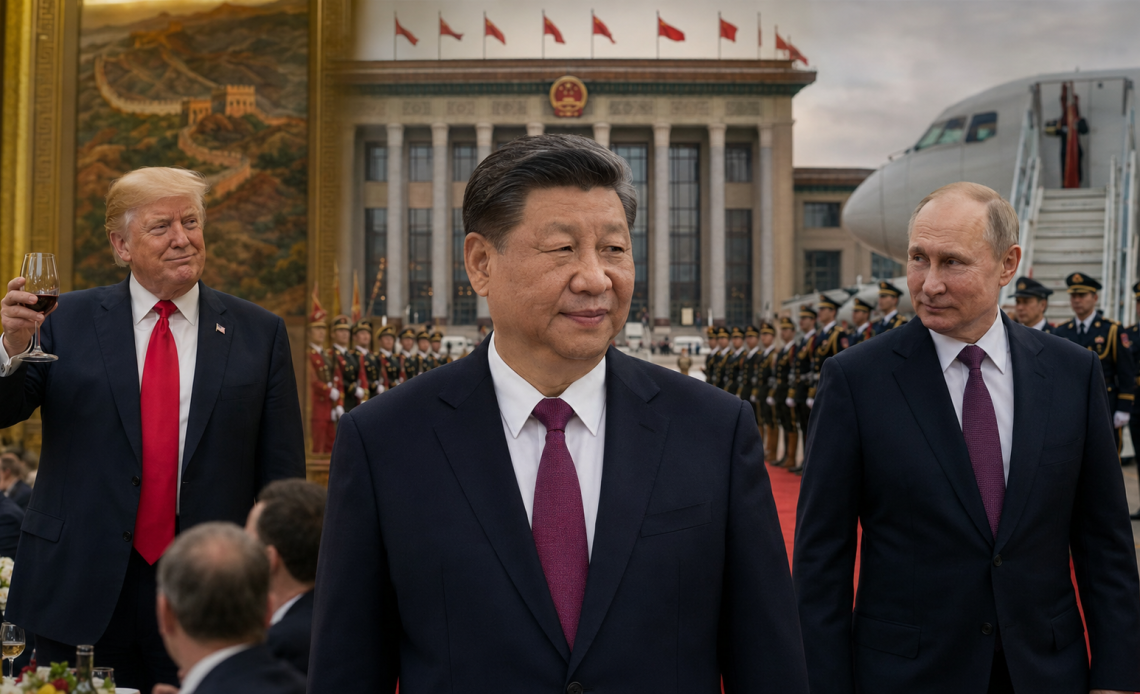
In Beijing, the choreography said almost as much as the communiques. Air Force One had barely left Chinese airspace before Vladimir Putin’s plane touched down.
The flags, guards and banquet halls were still warm from one superpower summit when China began staging the next.
For Xi Jinping, the sequence was not just diplomatic theatre; it was a live demonstration of leverage: America came looking for commercial wins, Russia came looking for reassurance, and both found themselves moving through a capital where the terms were set by Beijing.
The red carpet gap
The first message came before either summit began.
Donald Trump was received on the tarmac by Chinese Vice President Han Zheng, then treated to a tightly choreographed visit that included the Great Hall of the People, the Temple of Heaven and a rare stop at Zhongnanhai, the leadership compound at the centre of Chinese power.
Putin, arriving days later, was met by Foreign Minister Wang Yi, a warm welcome but a lower-ranking one.
The contrast carried a quiet irony.
“Trump went for cash, to put it bluntly,” said Alexander Korolev, a China-Russia scholar quoted by TIME.
“He went as a tradesman to sell airplanes and do some agricultural deals. But Putin goes more for strategic cooperation.” Yet it was the “tradesman” who received the more elevated arrival optics.
What each man came for
Trump arrived with a business-heavy agenda and a delegation that included some of corporate America’s most important China-facing executives.
The leaders from Apple, Boeing, Qualcomm, Tesla and Meta were among those joining the trip, while Nvidia chief Jensen Huang was added at the last minute.
The asks were familiar but substantial: agricultural purchases, Boeing orders, relief on rare earths and a more predictable path for US companies operating in China.
Putin’s needs were harder to price. He wanted confirmation that Beijing’s improving dialogue with Washington would not dilute the China-Russia axis.
Dennis Wilder, a former senior US intelligence official now at Georgetown University, argued that Putin would arrive in Beijing looking for reassurance that any improvement in US-China ties would not come at Moscow’s expense.
In a LinkedIn post before the visit, Wilder wrote that the lack of US pressure on China over its support for Russia’s war would make Putin “feel very comfortable going into Beijing.”
That mattered because Russia’s position is weaker than its summit language suggested.
Its economy contracted 0.3% in the first quarter of 2026, the first quarterly contraction in three years, while Western sanctions and the Ukraine war continue to narrow Moscow’s options.
Xi said yes, but not to everything
Trump left Beijing with measurable deliverables.
The White House said China agreed to buy at least $17 billion a year in US agricultural goods through 2028, approved an initial purchase of 200 Boeing aircraft and would address US concerns over rare earths and critical minerals such as neodymium, yttrium, scandium and indium.
Those wins were real, even if Beijing later described parts of the visit as preliminary and analysts questioned how much had been settled beyond the optics.
The analysts called the trip heavy on pageantry and thin on deeper breakthroughs, especially on Taiwan, Iran and broader strategic trust.
Putin also got a show of solidarity.
Xi and Putin oversaw more than 40 cooperation agreements, spanning trade, technology and media, and backed a 47-page declaration on a “multipolar world” and a new type of international relations.
But Moscow did not get the prize it most wanted: a firm Power of Siberia 2 pipeline contract.
The pricing, financing and contract terms remained unresolved, despite the Kremlin speaking of a general understanding.
Jack Burnham of the Foundation for Defense of Democracies argued that Russia’s failure to secure a final Power of Siberia 2 deal underscored the limits of Beijing’s willingness to deepen its dependence on Moscow.
The dependency Beijing won’t acknowledge
The imbalance is now difficult to miss as China is Russia’s largest trading partner, while Russia accounts for only a small share of China’s global trade.
Russia sources more than 90% of its sanctioned technology imports from China, including dual-use components important to drones and defence production.
Energy tells the same story as Russia is selling more to China because it has fewer alternatives.
As per public records, China imported about 2.01 million barrels per day of Russian oil in 2025, equal to 20% of its total imported oil by volume.
Putin aide Yuri Ushakov said Russian oil exports to China rose 35% in the first quarter of 2026.
The trade relationship remains large, though not frictionless.
Bilateral turnover fell to about $228 billion in 2025 after several years of growth, according to recent analysis, but the structure still favours Beijing.
China buys Russian energy at a discount, sells Russia the technology and manufactured goods it can no longer easily source from the West, and gains influence over Moscow’s economic future without formally assuming the costs of an alliance.
China’s masterclass in hedging
Xi’s real achievement was not choosing between Trump and Putin. It was hosting both, extracting value from both, and committing fully to neither.
For Washington, Beijing offered enough commercial substance to keep the relationship manageable. For Moscow, it offered enough strategic warmth to keep the partnership alive.
But in both cases, China kept the decisive cards in its own hands.
The experts described the back-to-back visits as a flex of Beijing’s growing diplomatic leverage, placing China at the centre of a fractured global order.
Andrius Tursa of Teneo said China held “strong leverage” because Beijing’s support had become increasingly important to Putin amid mounting economic pressure and military setbacks.
This was not simply a busy week in Beijing.
It was a reminder that the centre of gravity in global politics is shifting, not with a declaration, but with arrivals, handshakes, menus, pipeline delays and the quiet discipline of a capital that made two powerful men come to it.
The post Xi hosted Trump, then Putin, and showed where China’s leverage lies appeared first on Invezz